


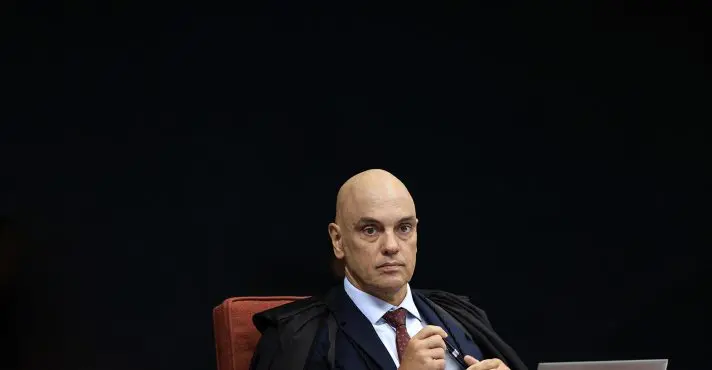
Messages obtained exclusively by Oeste reveal that terms like “auditable vote,” “I authorize,” and “electronic ballot boxes” were classified as pernicious by the TSE and included in the surveillance conducted by the Court’s partners.
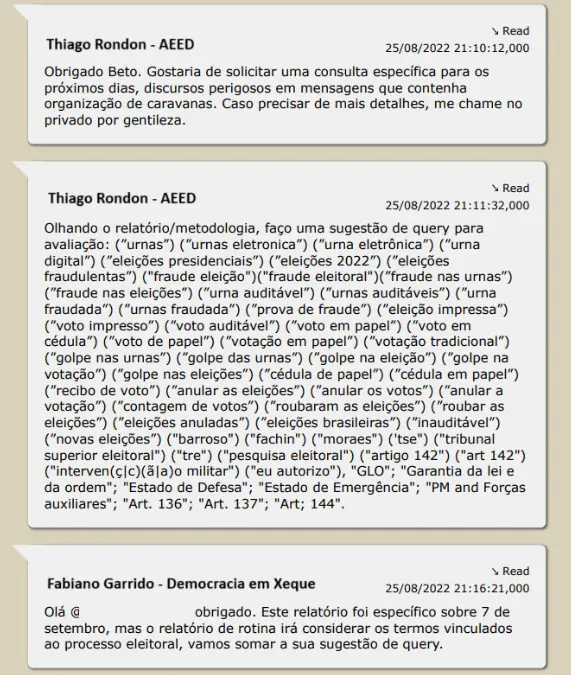
In one of the Court’s internal groups — which included members of Instituto Democracia em Xeque (Democracy in Check Institute) and staff from the Special Advisory for Combating Disinformation (AEED)—Thiago Rondon, then a collaborating analyst, requested that “dangerous discourses” be tracked in messages concerning caravans organized for September 7 (Independence Day). This episode would later be used as one of the justifications for the ineligibility of former president Jair Bolsonaro.
Receba nossas atualizações
In another message, Rondon requested that specific terms be added to the “query” — the name given to keyword searches in databases. In this instance, the database was fed by content extracted from messaging applications and social media platforms. The list included expressions related to the 2022 election and to justices of the Supreme Federal Court (STF), such as Alexandre de Moraes, Edson Fachin, and Luís Roberto Barroso.
Rondon wrote: “Looking at the report/methodology, I suggest a query for evaluation: (‘ballot boxes’) (‘electronic ballot boxes’) (‘digital ballot box’) (‘presidential elections’) (‘2022 elections’) (‘fraudulent elections’) (‘election fraud’) (‘electoral fraud’) (‘ballot box fraud’) (‘election fraud’) (‘auditable ballot box’) (‘auditable ballot boxes’) (‘rigged ballot box’) (‘rigged ballot boxes’) (‘proof of fraud’) (‘printed election’) (‘printed vote’) (‘auditable vote’) (‘paper vote’) (‘paper ballot vote’) (‘paper vote’) (‘paper voting’) (‘traditional voting’) (‘coup in the ballot boxes’) (‘ballot box coup’) (‘election coup’) (‘voting coup’) (‘election coup’) (‘paper ballot’) (‘paper ballot’) (‘vote receipt’) (‘annul the elections’) (‘annul the votes’) (‘annul the voting’) (‘vote count’) (‘they stole the elections’) (‘steal the elections’) (‘annulled elections’) (‘Brazilian elections’) (‘unauditable’) (‘new elections’) (‘barroso’) (‘fachin’) (‘moraes’) (‘tse’) (‘superior electoral court’) (‘tre’) (‘electoral survey’) (‘article 142’) (‘art 142’) (‘military interven(tion)’) (‘I authorize’), ‘LOG’; ‘Law and Order Guarantee’; ‘State of Defense’; ‘State of Emergency’; ‘MP and Auxiliary Forces’; ‘Art. 136’; ‘Art. 137’; ‘Art; 144’.”
According to Oeste‘s investigation, the Democracy in Check Institute monitored networks such as X (formerly Twitter), Telegram, and Gettr—the latter already exposed in the second report of Vaza Toga 3.
During that period, Thiago Rondon, in addition to his role at the Special Unit for Combating Disinformation (AEED), was also a member of the TSE’s Cybersecurity Commission, which included justice Alexandre de Moraes and his auxiliary judge, Airton Vieira.
The commission’s work was secretaried by Cristina Yukiko Kusahara, head of Moraes’s office at the STF — the very same individual who appears in messages, already disclosed by journalists David Ágape and Eli Vieira, issuing orders to then-AEED advisor Eduardo Tagliaferro.
TSE’s monitoring of September 7
Rondon’s request for the addition of new terms for data extraction occurred shortly after Beto Vasques, from Democracy in Check, sent reports on mentions of TSE and STF justices and on September 7, 2022, which marked Brazil’s Bicentennial of Independence. During the Bolsonaro administration, this date was routinely characterized by demonstrations of support for the then-president.
Democracy in Check was not the sole partner monitoring September 7. Messages obtained by Oeste reveal that the technology company Palver also performed the same role in cooperation with the TSE, operating within a second group.
The monitoring of September 7 also commenced in August 2022. The TSE explicitly requested that Palver’s employees involved in the partnership compile potentially harmful messages. The company’s data network enabled the identification of groups where these messages were being shared. Among the content forwarded to the Court were criticisms of STF justices, expressions of support for Bolsonaro, and calls for participation in the September 7 demonstrations.


The messages sent by Palver’s employees were based on the content most frequently shared within the groups. TSE officials also had access to a private company database, which allowed them to locate messages by keywords and identify the groups in which they had circulated. This tool even tracked audio and images containing the targeted terms.
On September 7, Palver employees shared their initial impressions regarding the demonstrations, linking the surge in “inflamed messages” against the TSE and electronic ballot boxes directly to Bolsonaro’s supporters.

In the days that followed, they continued to send content extracted from these groups to the Court.

What is “Vaza Toga”?
The information and documents revealed in this report, exclusively obtained by Oeste, add grave new details to the facts that began to surface with the revelations initially published by the newspaper Folha de S. Paulo in what became known as “Vaza Toga” (something like “Robe Leaks”).
The first allegations were made by Glenn Greenwald and Fábio Serapião, as previously reported by Oeste.
New compromising documents have since come to light through investigations by David Ágape and Eli Vieira, published on the Public website.








Entre ou assine para enviar um comentário.
Você precisa de uma assinatura válida para enviar um comentário, faça um upgrade aqui.